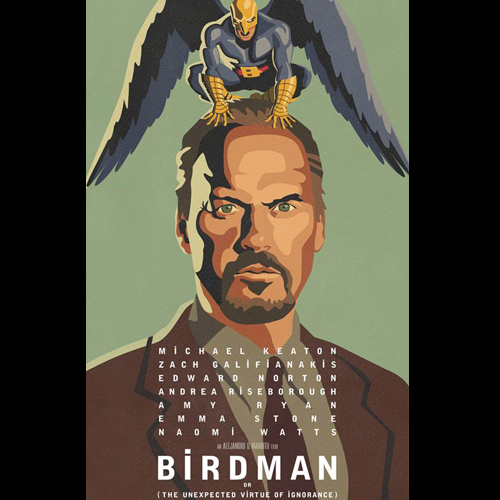
Alejandro Gonzalez Inarritu (Babel, 21 Grams, Biutiful) has served up an incredibly intelligent and entertaining criticism of Hollywood culture in his newest film Birdman (Or the Unexpected Virtue of Ignorance). At the same time, he challenges the idea of legacy and mocks "the stage" as well. With all the substance, he also mixes in some creative film making.
Birdman follows actor Riggan Thomson (Michael Keaton), a former Hollywood actor known for portraying the popular and extremely successful Birdman film series over two decades earlier. Riggan is attempting to re-emerge into the public spotlight by writing, directing, producing, and starring in his own play. Frustrated that no one takes him seriously as an actor because he once played a superhero, the entire play itself is both a means to return to relevance as well as vindicate him as an actor.
While putting on the show, he often has conflicts with co-star Mike (Edward Norton), who is essentially the polar opposite. Where Riggan was a movie actor with smashing box office hits, Mike was a serious stage actor who has long been receiving universal praise for his abilities. It becomes clear that Riggan maybe has a more relaxed vision of what acting is while Mike has a much more romanticized idea, one that causes him to disrupt scenes within the play when he deems something "too fake."
This juxtaposition of opinions is often used to promote commentary about Hollywood film culture: one in which box office records dictate the success of a film. At one point, Riggan has a conversation with his internal Birdman persona in which this gets brought up. What is success? Is something good just because it made millions of dollars? Who defines any of this stuff? Even more, why is Riggan unsatisfied with his career? He and his Birdman movies brought joy and entertainment to millions of fans? Is all of this, whether it is stage or film, just to stroke his ego?
In between mental breakdowns and the stress of trying to put on a play (in front of critics who resent him - a Hollywood blockbuster actor coming into "their field" - no less), he also tries to connect with his daughter Sam (Emma Stone), who is fresh out of rehab and resentful of pretty much everything. Over time, they have a weird connection stemming from a similar sense of frustration with everything around them.
It's hard not to notice how "meta" the film is. It's really hard not to see the parallel between Keaton and his character. Keaton - like Riggan - was famous for playing a superhero many years ago (it could even be argued that Keaton's "Batman" was truly the start of the modern superhero craze). And like Riggan, Keaton similarly disappeared from mainstream consciousness after his last superhero film. (A more specific parallel: Riggan's last time playing "Birdman" was in 1992, which was also the year Keaton last donned the Batman cowl.)

Even more, almost every one of the main actors has rotated between smaller, more independent pictures and the big Hollywood blockbuster. Co-stars Emma Stone and Ed Norton have similarly appeared in superhero movies in recent years (Stone in the Amazing Spider-man and Norton in The Incredible Hulk). Naomi Watts starred in the big budget (and big disappointment) King Kong remake (as well as appeared in Tank Girl, a comic book movie, though a much smaller one). Everyone's favorite bearded funny man Zach Galifianakis has also stared in the blockbuster comedy Hangover trilogy. Even Andrea Riseborough made a summer appearance alongside Tom Cruise in Oblivion. This casting is almost inherently commenting on the nature of Hollywood film, and how it inevitably sucks everyone in. Early in the film when Riggan is trying to find a replacement actor, he hears that Jeremy Renner can't do it because he's working on The Avengers, which prompts the response, "They put him in tights too!?"
The structure of the film is equally "meta." Taking a page from Alfred Hitchcock, Inarritu builds the film with primarily a handful of long, drawn out shots. There appear to be perhaps just a dozen or so cuts in the entire film. This gives the impression that everything is unfolding in one take (akin to Hitchcock's Rope, which is similarly done with every reel being one or two shots). Thus, the film whose plot is built around the staging of a play is itself filmed as if it were a play. In those moments when Riggan begins to slowly lose his mind, blockbuster-esque scenes occur around him. Eventually it devolves into a weirdness that sometimes can be tricky to fully follow.
Eventually, having had enough and wanting to prove his worth as an actor, he goes on stage with a loaded gun. On a personal note, I'm extremely sensitive to things dealing with suicide, so I found myself slumped in my chair, slightly hiding my face, whispering to myself, "I don't want to watch this" over and over again. It was one truly uncomfortable, anxiety-inducing sequence.
And as most truly great films do, it ends in a strange and ambiguous area. Without spoiling, suffice it to say that it might leave you scratching your head and discussing it with your friends for the next few days. Or, it's equally likely to make you go, "What the hell was that?" and cause you to dislike the film.
Weirdly funny at times, interestingly shot, super meta, and kind of weird, Birdman fast became one of my favorite movies of the past few years. It's probably the best movie of the year.

No comments:
Post a Comment