
PREFACE: I do mention a few specific plot elements that are SPOILERS. Not sure if people care about spoilers in a movie like this, but be warned they're there. Especially when we get past the racist party.
PREFACE 2: Worth noting, I guess, that there's pretty much no element of my identity that isn't part of the "majority." Straight, white dude who was working/middle class (depending on whose definition we're using - suffice it to say we weren't poor) and had a Catholic upbringing. Shoot, even the one thing that USED to be a minority identifier - being a comic book and video game nerd - is now mainstream pop culture.
Point being: probably worth it to take my opinion with a grain of salt. Not saying my opinions are somehow invalid as a white man watching the movie, but I don't have much insight in the "black community." I'd definitely be interested to see what black people thought of the movie and if they felt similarly or totally different. Or, if anyone thinks I'm totally off-base. This is just what I took out of it with what I generally thought going in. In general, I'm a big fan of diverse perspectives in media, so any time I get a main black or Latino or female character who isn't Tyler Perry in drag or a drug dealer or a mere love interest/goal for hero to accomplish, I'm always more interested.
ONWARD!
Race has a knack for being an issue that we all would benefit from having an open and honest conversation about while also actually listening to the other people who have had different experiences with it. In the case of the provocatively named Dear White People, director Justin Simien tries to give viewers some sense of what many black Americans feel like in today's world. That's what makes it something of an important film. It's a rare story told through a black lens about black experiences on their own terms. And it's surprisingly insightful, especially when hearing Simien talk about how many things were inspired by his own personal life experience.
In an age where Barack Obama has become President, black people find it almost more difficult to have their perspectives heard or understood. Taking place at a fictional ivy league school predominantly made up of rich white kids, one such student goes so far as to suggest that the hardest thing to be in today's work force is a white, middle class male (which could have felt like a forced line of douche baggery in the film if not for the fact that I've heard this argument by an annoying number of people in real life). He goes on to even suggest that the primary reason Obama is president is that he benefited from affirmative action. Even the president goes so far as to say, "Racism is dead in this country." To his black colleague, no less.
Primarily focused on following Sam White, a young black woman who is militant in her racial identity and hosts a school radio program called "Dear White People," she regularly pushes people's buttons. "Dear white people," she says in one radio show. "Dating a black man to piss off your parents is itself a form of racism." At other times, she's merely mocking. "Dear white people with Instagram: you go on hikes. We get it." Sometimes she's funny. Sometimes she's trying to point out microaggressions that a lot of people just ignore as being "no big deal." She's the one who is openly controversial in her anarchist persona, willing to set fires to make a point.
Hers is not the only perspective in the feature, however. There's also Colandrea Conners, a young black woman who is trying to get onto a reality television show. Her thing seems to be wanting people to notice her, and she often seems to reject her "blackness" in order to fit in. She's also taken to calling herself Coco, because her real name Colandrea "doesn't pass the resume test." (Basically meaning she is concerned that if people were know she's black before they have a chance to even meet her, that will set up a different experience when they do.)

There's also Troy Fairbanks, the hot shot black student politician who seems to know how to play to a crowd. He is the son of the Dean of Students. Liked by black and white students, he is essentially seems to "play it safe." Finally, there's Lionel Higgins, a gay black journalist wannabe who is so much struggling to find his place that the film makers don't even really let him have a home. He's shopped around housing as he goes from a house of predominantly white kids bullying him to a house of predominantly black kids bullying him. Lionel is calm and nice, often acting as a wallflower. Yet no matter how much he tries to avoid it, he still gets caught in the racial divide between the pompous Kurt Fletcher and Sam White. Even his new friends at the school paper make him uncomfortable and don't seem to care about him, really.
What's really interesting about these characters is that the don't just shine a light on the black experiences in a predominantly white environment. They also reflect that racial identity even among black people. Each and every one of these four main characters is also struggling with some issue within their own black community. Sam, for example, is romantically involved with a white man, but she's too scared to share that fact with the public. He even calls her out on it at some point, calling her out on feeling the need to "pick a side" when really, it wasn't as clear cut as that. Sam, whose mother was black and father was white, even points it out herself when she finally admits that she remembered the looks people gave her father when they'd see him with this little black girl. She hated those people for trying to make her father feel embarrassed or ashamed, yet there she was, trying to appease those same people who would be giving her looks for dating a white man.
Coco is overly concerned that people only see her as a black woman, then tries to take advantage of people's interest in "black culture" to her advantage. Troy tries to be the "chill black guy" with his white friends, trying to show that he's not easily offended by their ignorance. But his race is perhaps not as big of a deal to him as it is to other people. He's also something of a pawn for his father. His father was offered the position of Dean of Students after graduating second in his class. The person they made president instead of him was a white student who barely passed. Since then, he's been training his son to be completely elite and forcing him to live a life in which no one can possibly deny him any promotion or job. (This, coming at the expense of his son's desire.)

Most interesting of the bunch though is Lionel. He's the ultimate outsider. He's black and doesn't fit in with the white kids. But he also doesn't really fit in with the black kids either. Both black and white students joke with him about not "really" being black. One white student even says, "You're only technically black." The black kids don't say it outright like that, but they're certainly all implying it. Lionel struggles the most with his identity and finding his place as a gay black man. Even people who seem open to him are ultimately up to no good though. It's sad and heartbreaking, and he serves as something of a mirror on "black culture." At one point, Lionel and Troy bond over Troy's secret love of Star Trek (which he publicly denies, presumably because that's "not what black people are into.") That's what makes the feature compelling. It's not just about black students finding a place in a white world. Each of them is struggling to find their place in their black one as well.
The movie itself sometimes struggles to find itself as well. The first act builds it up to be a quirky indie comedy, complete with hyper stylistic title cards and transitions. Come the second act, however, it's trying more to force the issue. From start to finish, it's focus is primarily on microaggressions against black people. These are seemingly little things that contribute to making black people feel uncomfortable. It's things like saying, "You're only technically black." It's things like asking to touch someone's afro hair style, and doing so before he or she can even answer. And it's the way black people are portrayed on film and in television. Yet there's also a more serious perspective as well. Simien does give examples of more blatant issues as well, whether it's the issue of the Dean and the President, or if it's Kurt Fletcher's intangible disdain for Troy and making him jump more hoops than other people to get into the club.
It culminates in a Halloween-themed party thrown by a house of primarily white students in which the theme is dressing up and acting like black people. What ensues is a party of epic ignorance, as people show up in blackface, wear fake afros, cover themselves in gold chains and bandanas and wife beaters, and have a freestyle contest. Suffice to say, it's pretty racist. It's so much so that it coaxes passive Lionel into action. This event would seem completely absurd (and it is) if not for the fact that it was inspired by real world events, as these very parties started popping up at several colleges around the country - including Dartmouth.
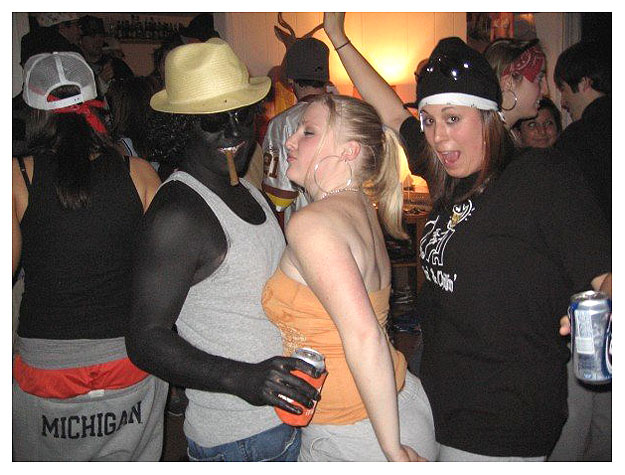 |
| Note: This is NOT from the movie. This is from a real college party... Can't make this shit up. |
The story surrounding the fictional party, however, leaves the viewer with a few philosophical questions to deal with. On the one hand, as much of an ignorant jerk Kurt was, he wasn't lying that he cancelled the party. He had no real intentions of throwing it. Even when the idea first popped up, he was the only one to have enough sense to ask, "Can we do this?" It's one of the few moments you realize that for all his ignorance and racial insensitivity, he's also not a complete idiot and jerk. It turns out that the party was provoked and invites got sent by the radical Sam. On some level then, it seems like this party wouldn't have happened if Sam didn't throw everything in motion to begin with. Her argument, and rightfully so, is that it never should have happened whether invites were sent or not. She argues that when people got those invites, they should have been disgusted. Instead, many people covered themselves in blackface and fake afros and headed over anyway.
Overall, the film struggles at times with what tone it wants to take and with its pacing. The Sam/Gabe love story could have had more screen time and relevance throughout the film (Gabe, by the way, looks a bit like a cross between Jim Halpert and Andy Dwyer). It's also refreshing to just get different black perspectives out there at all. As Sam points out before taking the stage for her campaign speech, "We live in a world where Big Mama 3 exists."

No comments:
Post a Comment